First Marketing Hire for Startups: Who to Hire and When
One topic that often comes up in my discussions with founders of early-stage startups is marketing talent.
For starters, how should they think about that critical first marketing hire? What level of experience is appropriate? What skills are must-have vs. nice-to-have? What traits should they watch for? What are the green or red flags?
While it can be challenging to reduce this to a one-size-fits-all checklist, it is helpful to keep a few key considerations in mind.
- <span class="richtext-line-highlight">Orientation: Growth vs. Foundations</span>
It’s foolish to compile a laundry list of all marketing skills/capabilities and expect your first hire to tick all the boxes. Don’t look for a unicorn. Hire for what you need in the next 1-2 years; don’t hire for what you might need years from now. You can do this later with more accurate information.
Assess where your business is today and what role you expect marketing to play.
Most marketing professionals fall broadly into these two orientations: Foundations and Growth.
Yes, some folks could position themselves as a mix of both, but their superpowers will likely be in one category.
As this is your first hire - you need to look for leverage or outsized capability where it matters, not average competence across multiple skills.
Remember to hire for strengths, not for the absence of weaknesses [all due credit to Ben Horowitz].
While it is essential that the founder and other C Suite members (Product/Sales) interview the prospective hire, including an actual marketer in the screening process is imperative to validate domain expertise. Reach out to senior marketers you trust from your personal or professional network to help.
A few of the roles & capabilities under each category:
A] Foundations Orientation:
- Product & Brand Marketing
- Creative Strategy & Content
- Organic Social
- Community
- Customer research/insights
Foundations-oriented marketers are skilled at ensuring the startup is clearly positioned with its ICP, whether through developing audience personas, creative & content assets, or driving organic engagement with communities.
These marketers focus more on strategy and building organically for the longer term than on an active go-to-market orientation. Activation plans can be managed via an agency or by hiring a growth marketer as the second hire.
B] Growth Orientation:
- Performance Marketing
- Lead Generation
- CRO & Analytics
- Affiliates
- Content syndication
- Events & Webinars
Growth-oriented marketers have a go-to-market mindset and can build an engine [i.e., repeatable process] to drive commercial impact quickly. They are action-oriented and data-driven, operate well in a test-and-learn mode, and work well with product or dev teams.
It’s important to note that some fundamentals need to be in place before they can genuinely scale and add value—e.g., the founder, product teams, and/or agencies should have developed [+vetted] the value proposition with the ICP, core messaging assets, and a basic website/app.
If you’re not sure what kind of marketer suits you, here are some broad recommendations by parameters:
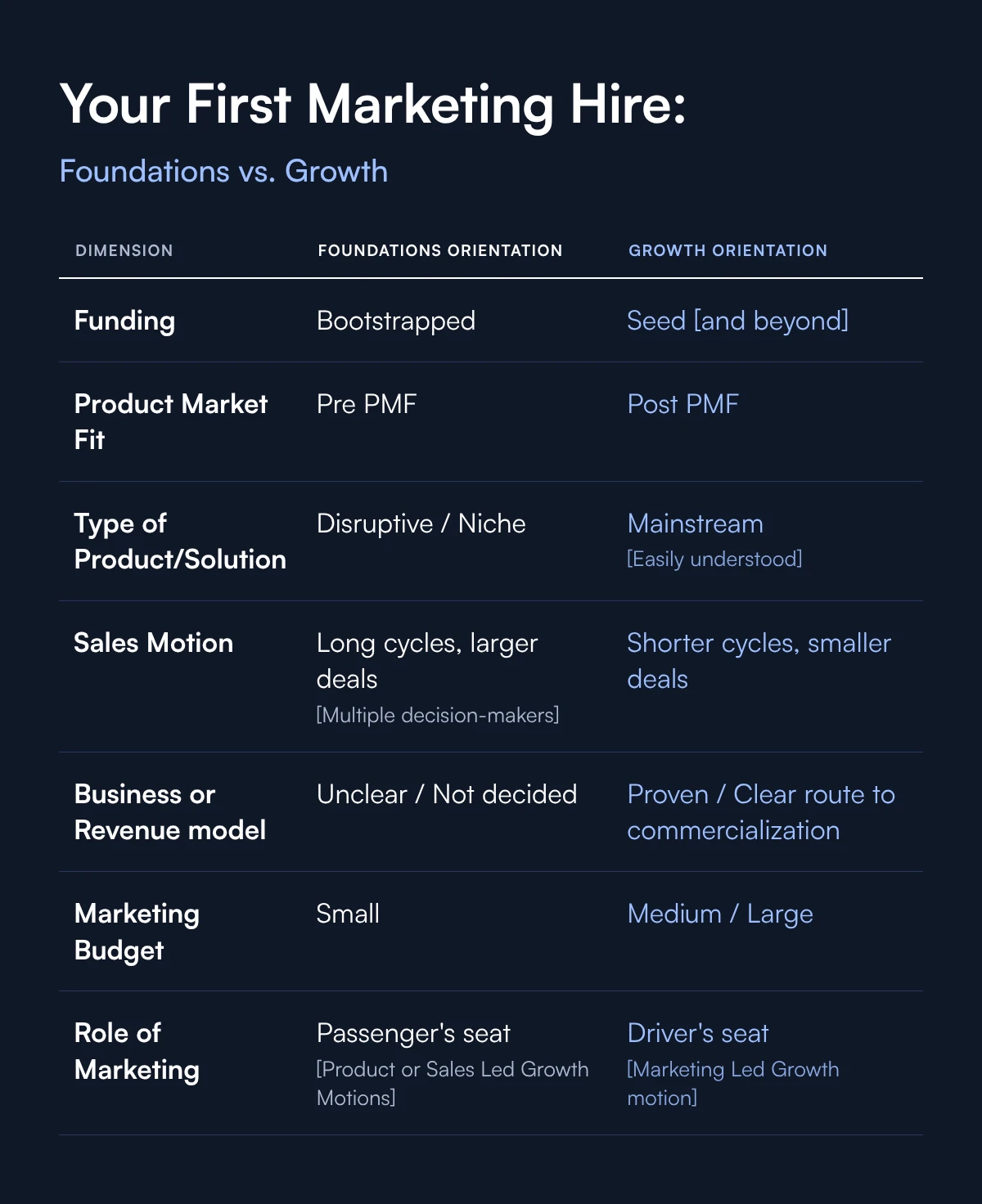
As mentioned above, you should bring in contractors or agencies to fill gaps as needed. But prioritize capabilities you want in-house for the full-time hire [e.g. what needs tighter alignment with business goals or seamless coordination with internal teams] vs. what you’re happy to outsource until you can hire more full-time staff.
Product marketing or growth: which comes first?
If your product is complex, the sales cycle is long or deal sizes are larger, I lean towards a product marketer first. That person works with sales on positioning and customer insight, and connects your product to your buyer; without that buyer context, marketing ends up brainstorming on its own. For deep tech, or any enterprise sale with multiple people influencing the decision, I'd hire product marketing first regardless of funding stage.
If you're in a more mainstream category with traction coming in, smaller deal sizes and quicker cycles, a growth marketer can come first, because the job is to build inbound and a lead generation engine.
Either way, hold off on a dedicated demand gen hire until you know what's working [which deals convert, what's repeatable]. In the early days it's founder-led sales anyway, and someone hired to generate leads can't do much before the engine is well-oiled.
It's also tempting to move a product manager or engineer into the role because they know the product. I'd keep them where they generate value and let them help the marketer get up to speed instead; if they want to grow into marketing, a share of their time [say 20%] is a better start than a switch.
What comes after the first hire
The sequence I'd follow after PMF: product marketing, then growth marketing to scale commercial outcomes, then martech/CRM or analytics as the third hire. Outsource creative and SEO/web dev initially, as long as your internal marketer owns and manages those partners. I'd bring SEO in-house only if there's sizable search volume in your category and it can be a durable edge. Specializations like content and brand come as you grow.
- <span class="richtext-line-highlight">Years of experience: Preferably 6- 8 years. </span>
Why is this the sweet spot?
A marketing professional with 6-8 years of experience should have enough functional expertise [ideally as a senior IC, i.e., individual contributor] to cut through the noise and decide what to focus on when resources are limited. Someone at this level would also have experienced both boom and bust economic cycles and would have the agility and resilience to adapt.
In addition, this person is likely to be more open to getting their hands dirty in execution vs. a pure strategy or team management preference that typically kicks in after 10+ years of experience.
- <span class="richtext-line-highlight">Mindset & Traits </span>
- You want the first marketing hire to challenge existing thinking and be comfortable pushing back against authority—albeit backed by sound data and judgment. This is the only way to transition from founder-led marketing to a marketer taking the reins.
Don’t hire a ‘yes’ person to execute the founder’s ideas; this would be a wasted opportunity.
- The first hire should be able to advocate for marketing with the founder/other CXOs and be able to “sell” initiatives to people who don’t understand marketing. Look for the ability to build a business case or budget from the ground up [e.g. zero-based budgeting]
- Highly motivated to prioritize & drive outcomes at a “0 to 70” phase [Build from Scratch] vs. a steady-state “90 to 95” [Optimize & Refine] phase.
- Curious above all else. Desire to experiment and learn as the company scales, including how related functions work, e.g., product, sales, or partnerships, as part of a broader go-to-market strategy.
- Works hand in hand with sales. Sales is marketing's reality check from the market, so look for someone who will work with sales on positioning and lead qualification, and feed what they hear back into messaging. This is where very junior hires struggle; they won't stand up to sales.
- Uses AI for scale, not for insight. A good marketer will use AI to streamline and automate; the strategy and the audience insight shouldn't come from an LLM.
A few sample questions to get you started:
- Tell me about a time at work when you disagreed with your manager on a project or campaign. How did you manage this?
- When did you last build a marketing initiative from scratch - i.e., without an existing playbook or precedent? How did you manage buy-in from other stakeholders?
- Tell me about a good day at the office for you. And what does a bad day look like?
- What was a new skill you learned this year? Work or non-work related? Why was this important to you?
- <span class="richtext-line-highlight">Full-time hire, fractional or agency?</span>
If you're very early [pre-seed, still validating], it's too early for fractional. What you need is some level of user validation and an ICP sanity check, and lighter-touch mentoring or a couple of hours of advisory can help the founder build those foundations.
At some point you'll need someone more hands-on and embedded in the team. True fractional makes sense at pre-Series A or Series A, once you've got some traction and the funding to drive scale; that's one to three days a week working with the founder, and it can include helping you hire and then handing off to your full-time marketer.
Agencies and contractors are good for tactical execution, and if you already have them, keep it flexible while you figure out what you need. They'll need a strategy person on top, though, because work done before the strategy is set isn't anchored to anything. Whichever route you take, keep ownership of strategy, ICP and positioning inside the company.
Looking for more? Here's a comprehensive hiring guide with 35+ questions to assess general competencies/traits and test foundations/growth marketing expertise.
Frequently asked questions
When should a startup hire its first marketer?
When you've validated your ICP and value proposition with early customers and are ready to move from founder-led marketing to a marketer taking the reins. Before that, founder-led marketing with light-touch advisory support is enough.
What marketing work should a startup do before hiring its first marketer?
Validate the ICP and value proposition with real users, put core messaging and a basic website in place, and understand which customers are converting. Your first marketer builds on this, and a growth or demand gen hire in particular can't scale without it.
Should the first marketing hire be a product marketer or a growth marketer?
Product marketing first for complex products, long sales cycles or larger deals. Growth first if you're in a mainstream category with traction and smaller deal sizes.
How much experience should the first marketing hire have?
6–8 years, ideally as a senior individual contributor: enough depth to decide what to focus on with limited resources, and still willing to get hands-on with execution.
Is a fractional CMO an alternative to a first marketing hire?
It can be at pre-Series A to Series A, when there's traction and budget to build a scalable motion, and a fractional leader can help you hire and hand off to a full-time marketer. Very early on, light-touch advisory is a better fit.