Marketing Strategy for Startups: How to Get Traction Before You Scale
When founders see my background at Google, they often ask for my point of view on scaling or paid acquisition. Very often, though, the basics aren't in place yet: the ICP isn't clearly defined, the messaging isn't clear, or the website and user journey have too much friction. Before you start to scale, it's worth checking how strong these foundations are and which need refinement.
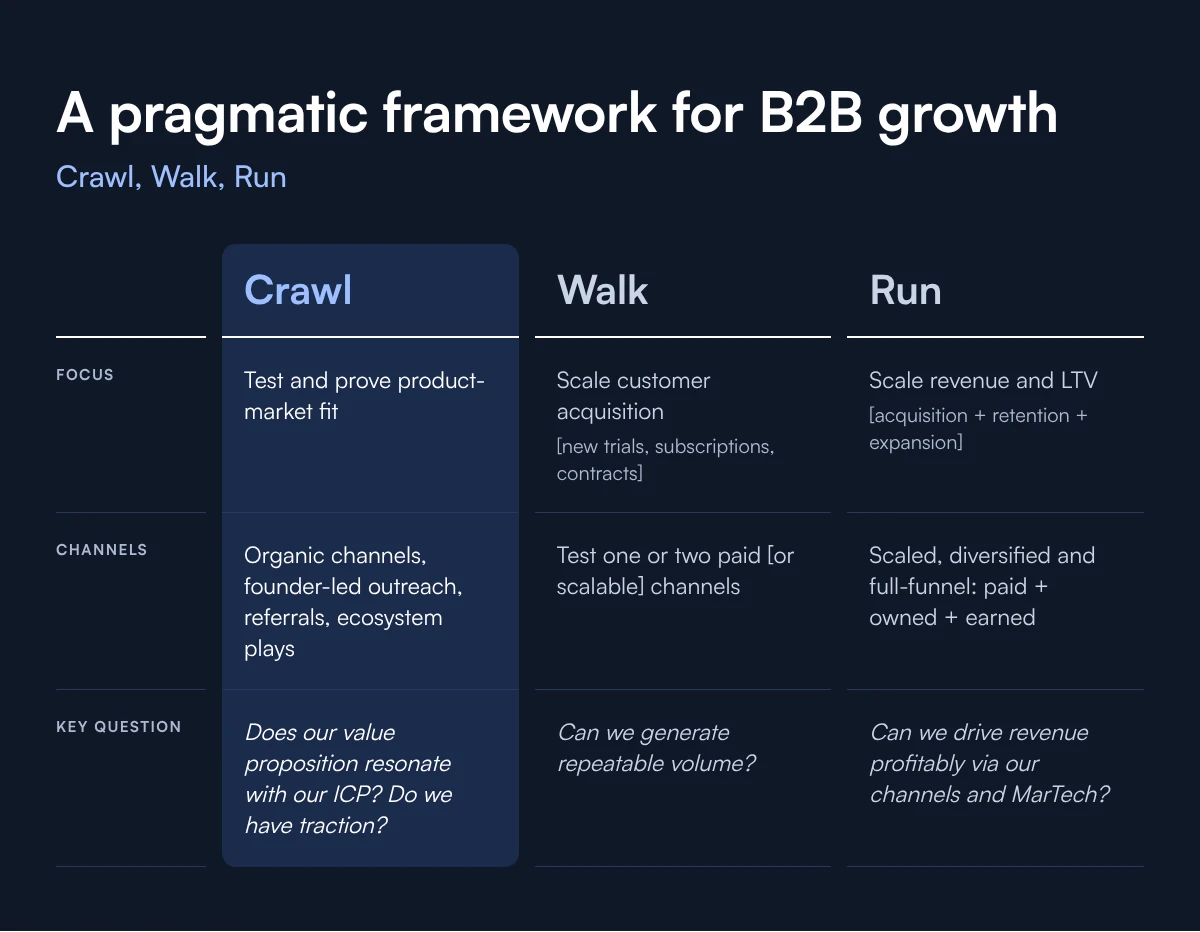
I use a simple framework, Crawl, Walk, Run, that maps to your overall lifecycle as a B2B business. It isn't one size fits all; your resources, your objectives and the channels you might test are different at each stage. Crawl is about testing and proving product-market fit. Walk is where you invest in scaling customer acquisition, and the key there is repeatability, moving from scrappy experimentation to something predictable. Run is about scaling revenue profitably across paid, owned and earned channels. This article covers Crawl.
What the Crawl stage is about
Crawl is zero to one. You have a unique insight on a problem, you're building your MVP, and you're looking for your first users and some signs of traction. You find those first users organically, through your network, referrals or communities. The two questions to answer at this stage are whether your value proposition resonates with your ICP, and whether you have traction.
You're experimenting here, trying to find users from wherever you can and get that early data. You're not very efficient, and you don't need to be. That changes in Walk, where over a period of time you should be able to say "I put in X, I got Y."
Prioritize one ICP before you think about reach
TAM in a pitch deck serves its purpose, because you're trying to prove your business is venture scale. But at some point the question becomes what you're building today, and who you want to talk to today. That's your ICP.
When you're early, you want to talk to everyone, but you have to build for the person who is feeling the most pain, and who is willing to pay to resolve it. A large segment with low pain intensity is less valuable than a smaller one where the need is urgent. And if there's no willingness to pay, you don't have a business, unless someone else is going to subsidize it.
Prioritizing one ICP doesn't mean it's the only segment you'll ever sell to. Most companies add ICPs as they scale, and each new one typically needs product enhancements, pricing adjustments or changes to the sales motion. Harvey is a good example: it first sold to law firms, and opened up to in-house legal teams at corporates much later, once the first ICP had scaled. The point is to build a wedge and solve for one segment first, before you add too many layers of complexity.
Reach happens later. Just because a segment is easy to reach doesn't mean there's pain there, so I'd look first at whether it's a viable segment, whether it's large enough, what the incumbent is and what they'd be willing to spend. Then you decide how to reach it; you might go direct, or through a channel partner or a hyperscaler. I've covered ICP, personas and the anti-ICP in more detail in how to validate product-market fit.
Channels for the Crawl stage
Founder-led sales
Some of the initial selling has to be founder-led, because that's how you learn what it takes to get a customer across the line. It might be three calls, two calls and a three-month POC, or a demo, and unless you do that a few times you won't know what to hire for. You also can't develop messaging or pitch decks until you know who you're talking to, and validating the problem from the user, in their own words, is the right way to start. I'm cautious when founders describe cold outreach as their primary mechanism; talking to your ICP in person at a conference will teach you a lot more.
Organic channels and community
Test an organic approach first [i.e. social platforms and the founder's own network] and learn what kind of content, in both messaging and format, resonates with your audience and breaks clutter in an increasingly crowded space. Testimonials and quotes from customers who are doing well with you work well here. Once you know what's working, you can add money behind it through paid social. Your founder story belongs here too: why you, and what is the non-obvious, earned insight? Nobody is convinced by a patent count. They're convinced by something you know because of what you've lived.
Partners and ecosystem plays
A partner ecosystem can be very important, particularly where a trusted gatekeeper already holds the relationship with your buyer. But sometimes startups sign a partner too early, before they've validated the buyer and understood the buyer's world. If you don't have that direct customer conversation, you're leaving it to the partner, so it's important to validate your own assumptions first. When you do sign, vet their customer base and know why you're working with them. Sell alongside them so you don't lose customer intimacy; what works well is building a reference deployment or case study together, and co-hosting roundtables and events.
Early milestones: references and pilots
Customer references
Most buyers hesitate to be the first to try a new product. The person who picks you first takes the most risk, because until then you're unproven, which is why the moment you have a first customer, you should ask to put them on your website. Selling to your second customer becomes easier, and the more recognizable the name, the easier it is; the next buyer assumes that customer has done a lot of due diligence already. There are ways to talk about impact without revealing actual numbers, for example improving X by Y percent rather than a dollar value, and in most cases customers are comfortable with that. It's always more valuable when your customers vouch for you than when you make the claim yourself.
Pilots and POCs
Pilots and POCs are now expected in any regulated industry, but a funded pilot is not PMF. A pilot is a heavy commitment on both sides, so make sure it is with your ICP; otherwise you risk spending significant product and engineering effort on the wrong customer. Secure executive buy-in, and define success metrics upfront with the person who signs. Both sides should be clear on what makes the trial successful, so agree this explicitly and avoid metrics that are very difficult to prove. During the pilot, start with training and onboarding, so the customer's team knows how to use the product and can get to value [or prove the POC outcome]; this is particularly important for a complex, technical product. Then work with them to drive usage, because without it the annual contract is unlikely to follow. Pilots that run too long become open ended, lose support and rarely convert, so aim to keep them to three months. Finally, avoid doing POCs for free. Many customers have POC budgets, and there is room to be creative on pricing [e.g. offsetting the cost of the POC against the contract if it converts].
Why paid acquisition can wait
Paid can amplify your acquisition efforts [and efficiently if managed well], but avoid using it to validate. If your campaigns don't work, it will be difficult to unpack why, because there are many moving pieces: the channel, the audience, the creative, the bid strategy, the landing page, or at a more fundamental level, whether the product has proved it should exist. If you've not proved that, why would you spend money to acquire new customers? I cover this in more detail in a separate article on performance marketing before PMF.
Premature scaling is something I see a lot, and it often starts with the thinking that "I have PMF, I want to scale, I want to spend." A round gets raised, a sales team is hired and paid channels are switched on, and it's only six months later that it becomes clear the early signals came from a narrow set of early adopters, and that segment doesn't generalize.
Your website at the Crawl stage
Your website should communicate your value clearly within about 10 seconds, as a benefits statement and not feeds and speeds, framed around the specific problem you solve for your target industry. Display logos, testimonials and awards, ideally above the fold, and map the journey with clear next steps and calls to action.
If you're sales-led, you don't expect a CIO to come to your website and sign a US$200k deal; they'll have a lot of questions on security, compliance, integration and customization. So the site should help them judge fit before a call. Be transparent on pricing [or at least call out what's free], make use cases and FAQs easy to find, and give your internal champions the numbers, proof and ROI they need, so leads are already qualified when sales steps in.
Set up analytics from day one, and add "how did you hear about us" to your forms, because LLM and peer referrals are understated in analytics. A lot of founders vibe-code their websites now, which is easy to do, but a site built entirely in JavaScript can be slow and invisible to LLMs. If your information is well structured, much of what works for SEO still helps with AEO; you may not get cited for top-of-funnel queries, but you can get cited for anything very specific to you, like vendor comparisons or FAQs [more on AEO for newer sites].
What to measure before you move to Walk
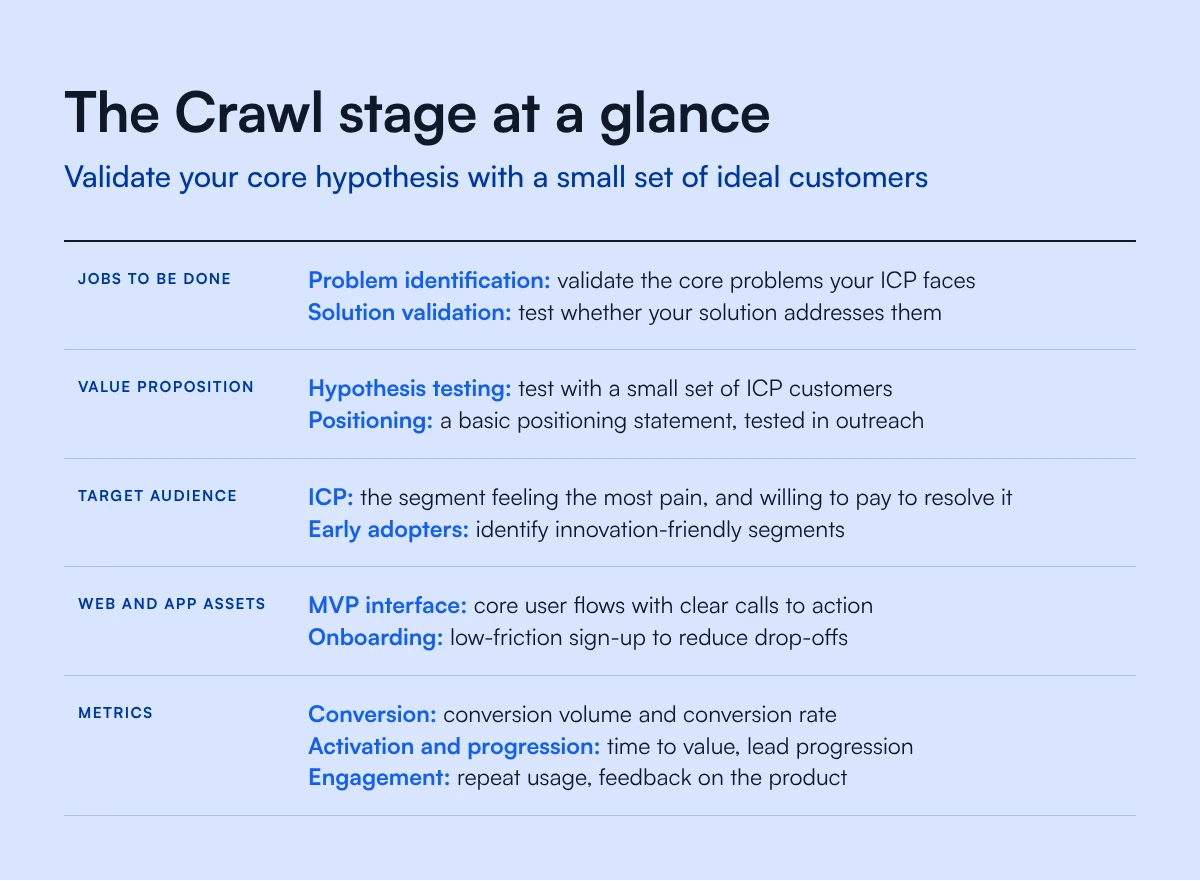
In Crawl, I'd look at conversion volume and conversion rate, time to value, lead progression, and repeat usage alongside feedback on the product. If users are taking a long time to see the value in your product, something is not working. You may need to rethink the time to value, or invest more in onboarding. Or it could be a question of whether you're talking to the right user at all. Keep track of these numbers, because when you test a new channel in Walk, you'll want to see how its lead progression performs versus your baseline, and that baseline comes from Crawl.
Retention is the gold standard for PMF; the leading indicators to use before you have clean retention data, and the false positives to watch for, are covered in how to validate product-market fit. Before you scale marketing spend, also check the pre-conditions for paid: if your value proposition isn't compelling, you're not getting retention, your organic channels aren't converting and you don't have a clear sense of your unit economics, you shouldn't be scaling marketing spend yet. Once they're in place, you're ready to Walk.
Frequently asked questions
What should a startup marketing strategy focus on before product-market fit?
Testing whether your value proposition resonates with your ICP and whether you have traction. Prioritize one ICP, find your first customers through founder-led sales, organic channels, referrals and partners, and learn from those conversations before you invest in scaling.
When should a startup start running paid ads?
When you know what's working: a compelling value proposition, retention, organic channels that convert and a clear sense of your unit economics. Paid can amplify your acquisition efforts, but avoid using it to validate.
Why does founder-led sales matter at the early stage?
Selling yourself shows you what it takes to get a customer across the line, whether that's three calls, a demo or a three-month POC. Unless you do that a few times, you won't know what to hire for, or what to say to the customer.
What metrics should an early-stage startup track?
Conversion volume and rate, time to value, lead progression and repeat usage, alongside feedback on the product. They show whether your value proposition is landing, and they become your baseline for new channels in Walk.


